Why Logic Doesn't Substitute for Information

I’m an information professional, and today I want to talk about the difference between logic and information, or maybe the ways in which a logical inference is different from information.
I’m about to talk about how logic is not your friend in doing research, so hang with me because this is about to, I guess, get very illogical.

Damn it, I should’ve said HIGHLY illogical…
What Is Logic?
A lot of us think of logic as “being smart.” If something is “logical,” it’s smart.
But something can be logical without being correct or being smart.
Logic is defined as: a science that deals with the principles and criteria of validity of inference and demonstration : the science of the formal principles of reasoning.
And in order to understand that, we need to understand that the second definition of “infer” is “guess.”
A classic example of logic: Where there’s smoke, there’s either fire or a delicious brisket in the making.
We see smoke, we guess there’s fire. We don’t KNOW that there’s fire, but in most situations, the presence of smoke can safely be assumed to indicate fire.
Basically, logic is a system meant to make guesswork a little more rigorous and that’s meant to bring you to a valid conclusion.
It’s reasoning, it’s a step-by-step way of figuring something out.
What’s Missing From Logic?
There may or may not be a formal gap between steps. In other words, how large a leap is permissible in logic? Do all leaps need to be of the same distance? Or, can we go from small leap to large leap, and then back to other small leaps?
The tolerance for what is and isn’t logical is different from person to person. Or: It’s pretty subjective.
What people do may not necessarily conform to logic, or logic may not be the most important factor. Why do we have French Toast for breakfast? What about French Toast, logically, dictates that it’s a morning food?
And if you’ll let me briefly switch to information/data:
How wide can the gap be between pieces of information before it’s invalid? Uh, none. None gap.
What’s the tolerance for what is and isn’t factual information? I think we’re in an era of alternative facts and alternative research, but most legitimate research efforts will result in an objective conclusion.
What people do does not necessarily conform to information, either. We can know things that we completely ignore.
How Is Logic Often Used?
The “Do My Own Research” crowd will often make their case with an argument like this: Big Pharma has a lot to gain from COVID vaccines, so if information comes through that vaccines are harming people, they’re likely to cover it up because it would be tremendously costly for them. Follow the money, you sheep!
Now, this has a nugget of truth to it. With COVID vaccines, there was money made, and the numbers are pretty staggering. Pfizer made $35 billion in European public contracts. Which sounds like an INSANE amount of money, but consider for a moment: Elon Musk’s net worth increased by $200 billion in the last year, mostly thanks to the bets he placed on Donald Trump.
I don’t want to confuse too many issues here, what I mean to say is that while $35 billion seems like a huge amount of money, one individual made 6 times that much in the last year.
Not to mention that the COVID vaccines from Pfizer did a lot of public good and were very much worth the price of about $17.75 per vaccine. The average hospital visit for COVID cost folks about $1,200 dollars out of pocket, when they were well-insured, so that price differential seems like a pretty good deal.
It’s factually true that big pharma stands to make money from things like COVID vaccines, and one could use logic to say that this might result in shady practices such as obscuring safety records.
But there are problems with that idea.
Logic Versus Data
Logic is a good tool to use when data is not available, and in our world, the instances where data is not available are becoming fewer and fewer.
The safety record keepers and VAERS are not working for Pfizer on any level, so they have no incentive to hide their data.
Logic is inferior to data when data is available. And in most of today’s situations, especially global ones, data is available.
Logic and Evidence
When you say Big Pharma is doing a coverup, and when you won’t accept evidence to the contrary, you’re putting yourself in a position where being right is more important than being correct.
If you find out there’s a conspiracy at play, you’ll pat yourself on the back for being right.
If there’s no evidence of a conspiracy at play, or even evidence against the conspiracy, you’ll continue assuming you’re right, and that someone is covering up the truth.
So, see, there’s no path, using that logic, that leads to, “I was wrong, there’s no coverup here.”
If your logic is set up in such a way that you cannot be proven wrong with hard evidence, then your logic isn’t really about truthseeking, it’s about feeling smart.
Logic That Ignores Swaths of Scientific Knowledge
Here’s a scientist explaining why you can find the same ingredients in Lucky Charms that you can in products meant to strip paint at Home Depot:

 Tiktok failed to load.
Enable 3rd party cookies or use another browser
The makers of the original videos are using logic. They see an ingredient named on a box, then see that ingredient is used for something else and is not fit for human consumption, and they infer that the food using that ingredient is bad for you to eat.
And, like Dr. Jessica Knurick says, that’s ignoring basic chemistry.
“I don’t want to eat X, X is present in a food, therefore that food is poison,” is a logical path, a reasonable string of logic, but it only works if you ignore science.
Brief Interlude: The Balls on These People
If you think you’ve discovered a long-held secret in the grocery aisle, related to an ingredient that’s listed on the side of the goddamn box, you’re PROBABLY wrong.
It’s the balls on these people, you know? The gall.
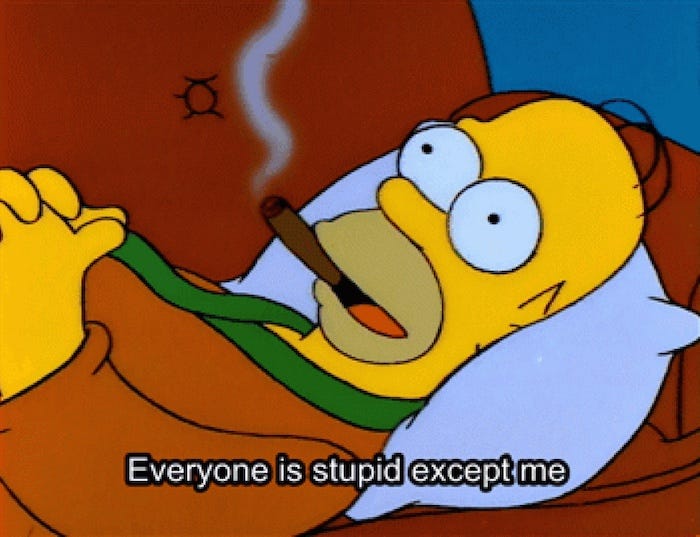
And who is perpetuating this lie? Big Leprechaun? C’mon.
By the way, is anyone in the room under the impression that Lucky Charms and Cinnamon Toast Crunch are healthy things to eat? I know they’re not. You know how I know that? Because they’re goddamn delicious.
Let Me Provide a Logical Example
I read a memoir once (of the Isla Vista shooter, weirdly) where a guy describes how, as a pre-teen, he was very short, and he wanted to grow taller.
He noticed that people who played basketball tended to be tall. So, in his kid brain, he thought that if he played a lot of basketball, it would cause him to grow taller. And he played a shitload of basketball and always remained pretty short.
It’s a detail that always stuck with me because, well, it’s very human. It’s dumb kid logic, the type we all used.
Logically speaking, it’s sound. If we ignore data, if we ignore what we know about science, it does make sense. Two things are associated with each other, therefore one may be causing the other. Unfortunately, the kid got the order wrong, and tall people probably tend to find more success in basketball. I mean, it’s one of the few sports where height does provide an immediate and obvious advantage.
Does the hoop really need to be THAT high, guys? Couldn’t they just make it like 5 feet up?
Anyway, basketball people don’t become tall, tall people become basketball people.
Again, this is excusable for a child. This isn’t unreasonable for a child. This is also excusable for people living in the 90s or earlier when information was not available in a tiny rectangular device that you have in your pocket right now.
It’s amazing to me that we live in 2025, when we can all look up something like, “Is trisodium phosphate dangerous in foods?” and can get many results, including this one from 2017 that points out, No, it’s not unsafe, and which also shows us that these viral “health tips” come in waves—it’s amazing that we have more access to better information than ever, and we ignore it.
I understand the use of logic and think it’s a great STARTING POINT when you’re thinking about something, but the only reason I see for starting AND ENDING with logic is because you’re less concerned with the truth than you are with something else.
I mean, there’s always another algorithm to beat so you can sell your wellness nonsense, right?
When Logic Can Work
When I’m playing The Legend of Zelda: Ocarina of Time, logic dictates that in order to access certain areas, you need certain tools. And logic dictates that once I’m deep into a dungeon, I should have all the tools I need, so solving a puzzle should just be a matter of figuring out which of my current tools is needed. Logic dictates that the game is not designed in such a way where I can become trapped, jump down a well and be unable to escape. I mean, it’s not Fear & Hunger, which lets you jump down a toilet hole from which there is no escape.

Ocarina of Time is solvable using logic because it was created by a person to be logical.
But here’s the thing, guys: The real world wasn’t created by someone as a puzzle for us to solve. It wasn’t designed in such a way that we were meant to be able to puzzle it out.
I’m not talking anti-religion here, either. Even if you believe there is intelligent design behind the world, it’s not a stretch to assume god didn’t intend for that design to be transparent to humans.
And, again: If this was a true matter of life and death, if someone was like, “I’m going to infect you with a deadly disease if you don’t figure out this puzzle,” it would be idiotic for me to go through the game using logic when I could hop online and find all the answers.
Why Logic Fails Most Often
Because the EXACT logic being used to threaten things like vaccines also works against the people who are threatening vaccines.
If we are logically saying that Pfizer has a lot to gain from vaccines being on the market and enforceable, we also have to say that people who are opposed to vaccines, like RFK Jr., ALSO have a lot to gain from being ANTI-vaccine.
It would seem that RFK Jr. made about $2.2 million dollars between 2017 and 2023 from the “non-profit” he founded, Children’s Health Defense, which is hugely against lots of scientifically-backed public health initiatives like fluoridation of water and vaccines.
Just because it’s funny/unfunny, apparently RFK underreported his earnings by almost half a million dollars when he was running for President, an accident he says he made by confusing net pay and gross wages. Which sounds like some pretty hefty bullshit to me, I can’t possibly imagine this dude is sitting down with an adding machine with one of those rolls of paper on it to do his own taxes.
And this guy is making decisions about your health. Someone so fucking rich that he sort of misplaced half a million bucks.
Any way you want to underreport it, $366,000 dollars a year is pretty far from “nothing to gain” from being anti-vaccine, eh? That’d be like me saying I have “nothing to gain” by having my job. That’d be like me saying that 6 times in a row.
I have nothing to gain by having my job.
I have nothing to gain by having my job.
I have nothing to gain by having my job.
I have nothing to gain by having my job.
I have nothing to gain by having my job.
I have nothing to gain by having my job.
And so here’s where we end up with the problem: the logic that says Pfizer is hiding vaccine damages to maintain its financial position is identical to the logic that says RFK Jr. is promoting false information.
Logically, they’re the same. Same concept, same logical path.
So, in this case, logic does not give us any insight into who is right or what is best for all of us to do.
Data is Responsible
Disseminating data means you’re spreading information. You’re being responsible. You’re looking into things before you snap off a TikTok in the cereal aisle.
Spreading logical inferences is spreading potential misinformation.
Why not just check? Just look into it? Like, a little?
If your logic is good, you’ll probably find evidence to support it. If your logic sucks, you probably won’t.
Data should be you first stop, but if you’ve come this far and still feel undecided, you, at the very least, need to not stop short of examining whether the data agrees with your logic.
A Final Plea
Logic that isn’t backed by science can get you killed.
People like RFK Jr. and their anti-vaccine bullshit killed 83 people in Samoa during a measles outbreak, many of them children.
During this outbreak, Samoa got a preview of 2020 with lockdowns, masking, and other initiatives meant to slow the spread of this disease.
During this time, people were told to stay home and to put a red sign on their door if they wanted a mobile vaccination unit to stop at their house and give them vaccines.
One of these vans was staffed by Fonoifafo McFarland-Seumanu, a nurse who also happened to be Miss Samoa.
So, like, just to be clear, you could listen to this former heroin addict, raw milk drinker, super rich guy, and current steroid user, whose logic is pinballing the ship through some mighty chilly, iceberg-laden waters:

You could trust his logic, which is always, ALWAYS debunked by data.
Or you could accept a free vaccine delivered by Miss Samoa:

We live in a world where the winner of a beauty pageant is a better, more informed, more helpful, more useful health professional than the head of Health and Human Services for the United States.
Because she’s smart enough to go on more than just logic. She’s smart enough to know that we don’t have to rely on logic alone.
And she gives enough of a fuck to educate herself and help people.